By far, one of the most frequent edits I make when reviewing and proofreading a document is to convert the double spaces between sentences to single spaces. And let me take no more of your time before getting straight to the bright-line rule: There is simply no reason to use double spaces.
O.K. There’s ONE.
But that’s it.
And let’s be clear. We are talking about two spaces between sentences. We are not talking about double spaces inserted between lines of text. Double spaces between lines = good. Double spaces between sentences = bad.
While it’s been a long time in the making, we are finally at a point that nearly every authoritative resource for writers is in agreement: drop the two spaces after each sentence. For over a decade, the Chicago Manual of Style, the Associated Press (AP) Stylebook, and even Federal Court rules dictate against their use. More on that in a minute.
But… Why did we ever?
First, let’s back up a bit to see how we got here. For those of you who grew up with a digital device in your hands, you likely don’t remember a time when double spaces were desirable, and even preferred. Let’s revisit that time, if just for a moment.
Those of us who are slightly older will remember those days with mixed emotion. Apples were something you gave your teacher. And if you were lucky, your teacher didn’t make you want to cower behind the nearly immovable typewriters in “Typewriting Class.” “Two spaces between sentences!” the teacher would bark. “There are no exceptions.”
“Two spaces between sentences! There are no exceptions”
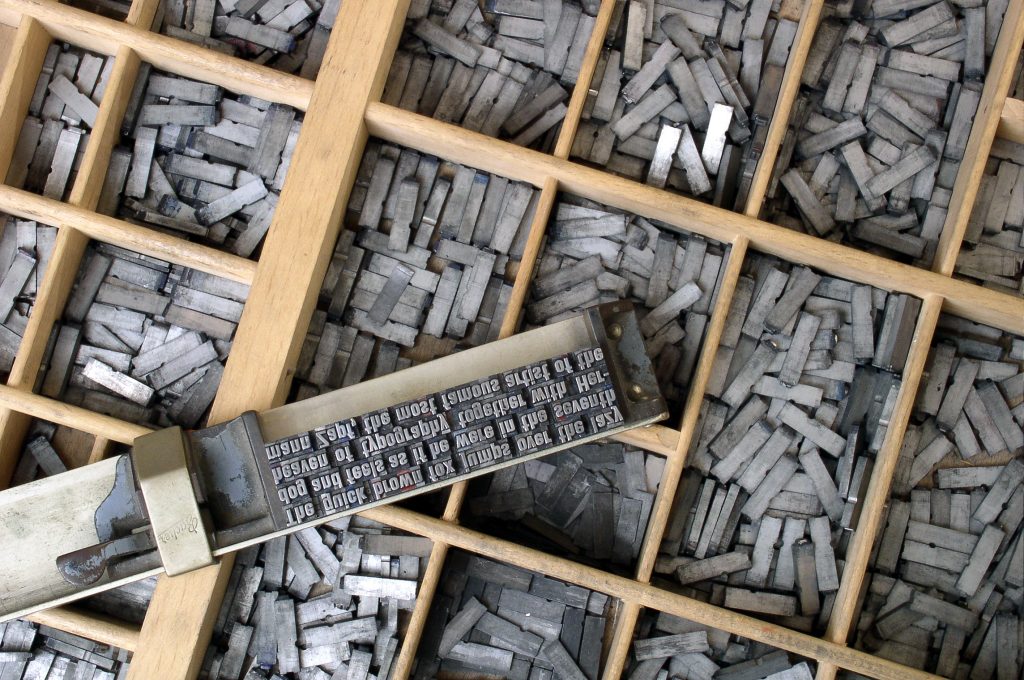
Backing up even further, long before typewriters, printing presses used double spaces between sentences because typographers told us it looked better that way. With a page full of text, the double spaces made it easier to see the sentence flow, and to identify a change of thought.
The advent of word processing led to the widespread use of proportional letters instead of monospaced letters. For example, the letter “I” is now much thinner than the letter “M,” and the endings of sentences are far more distinguishable. Our digital age has rendered double spacing obsolete, and to many readers, a double space can be distracting, if not disqualifying.
Back to the Present
In this mobile age, in all likelihood, you are reading this from an iPhone or iPad. And you are probably well aware of one of the most frequently used iOS shortcuts: tapping the space twice to insert a period between sentences.
Is that Apple’s nod to the older printing press and typewriter days? Undoubtedly. Is it confusing some of us into thinking there should be two spaces between sentences? Absolutely. But notably, if you ever go back and check how many spaces were actually inserted, you will see that Apple was smart enough to delete one of the spaces, inserting a period in its place. Just don’t make it a habit you carry over to your document editor.
So What Do the Authorities Say?
I thought you would never ask. The Chicago Manual of Style and the AP Stylebook have been in agreement for over a decade: drop the double space. For 95% of the authors out there, that’s all you need to know.
For attorneys, you may find that some courts have even added this dictate to their rules, telling you not to litter your court’s submission with double spaces. The Seventh Circuit, for example, states that extra spaces lead to what they call “rivers” — large, meandering areas of white space running down the paper. Their rules say, “Put only one space after punctuation.” (See the Requirements and Suggestions for Typography in Briefs and Other Papers, bottom of page 5).
And Here’s That One Exception…
The American Psychological Association (APA) Publication Manual remains the last relic of the double-spacing era of time. And even their rules permit it in one limited situation, with no guarantees that future editions will continue to include it, given its general disuse.
But first, it is important to note that the APA Style is used most commonly for scientific journals and papers. This likely explains why the exception persists, and some argue this remains out of a courtesy to the professors.
Specifically, Page 87, Section 4.01 of the most recent version (Sixth Edition) reads:
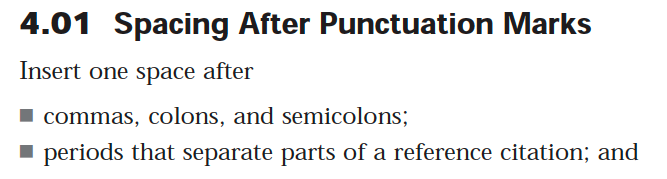
And if you stopped there, you’d understandably believe that single spaces rule the day. But a careful reader turns to the next page and sees this:
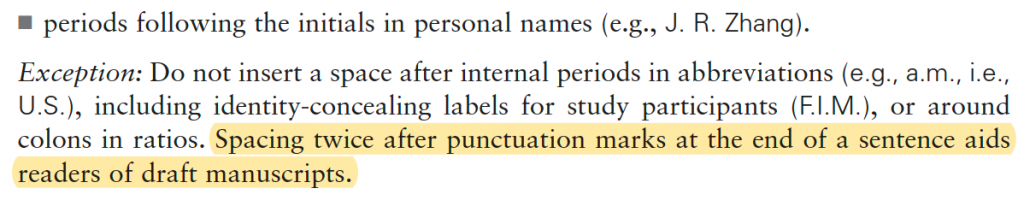
And there it is. Adding that second space “aids readers of draft manuscripts.” Should you do it? It doesn’t even say it’s recommended. It just says it aids readers. And then of course, see Rule #1 before you submit the final. Very tricky!
But here’s what that means. In your drafts — and particularly when your professor or more senior colleague tells you to do so in your drafts, sprinkle in those double spaces. Just make sure that you take them out when you finalize your submission.
And most importantly, your finalized single-spaced manuscript will impress your most astute readers. And that’s why we write, right?
—Chris Haigh
Updated 4/27/20:
In today’s news, (originally reported last week by TheVerge): Microsoft Word now marks two spaces between sentences as an error. The office suite world has taken sides! —CEH